
Team Dynamics Are the #1 Predictor of Performance.
Most Organizations Never Measure Them.
Google studied 180+ teams and found that who was on the team — their skills, seniority, personality — didn't predict performance. How they worked together did. Communication patterns, psychological safety, clarity of purpose. These dynamics are measurable, and the organizations that measure them dramatically outperform those that don't.
Team health measures how well a team functions across observable dimensions — psychological safety, clarity of purpose, role clarity, communication quality, trust, autonomy, collaboration, learning culture, well-being, and accountability — rather than what it produced last quarter. The dimensions are not aspirational: Google's Project Aristotle studied 180+ teams and found that who was on the team mattered less than how they worked together, and MIT's Human Dynamics Lab found that communication patterns alone predicted 35% of performance variation — as much as all other factors combined. Healthy teams produce reliably better work over time; unhealthy teams produce a quarter of strong output followed by attrition, rework, and rebuild. The measurement is usually anonymous and recurring (weekly or monthly), scored 1–5 per dimension, and most useful as a trend line rather than a single number — the value is in the conversations triggered when a dimension drops three weeks in a row, not in the absolute score itself.
Organizations measure individuals. Teams are where performance happens.
Performance reviews, engagement surveys, competency assessments — almost every measurement system in HR targets the individual. But work gets done in teams. When a team's dynamics break down, no amount of individual talent compensates. And by the time dysfunction surfaces in turnover or missed targets, it's already months too late.
Who is on the team doesn't matter. How they work together does.
Three decades of research — from Hackman at Harvard to Google's Project Aristotle to Pentland's sociometric sensors at MIT — converge on the same conclusion: team performance is a function of dynamics, not talent. And dynamics are measurable.
Google's Project Aristotle identified five key dynamics of effective teams: Psychological Safety (can I take risks without feeling insecure?), Dependability (can I count on teammates?), Structure & Clarity (are goals and roles clear?), Meaning (is this work personally important?), and Impact (does our work matter?). At MIT, Alex Pentland's Human Dynamics Lab proved these patterns are so consistent that researchers could predict which teams would outperform without ever meeting the members. Mistvine's ten health dimensions map directly to these frameworks — plus Edmondson's psychological safety research, Self-Determination Theory, and the Spotify Squad Health Check.
What changes when you measure team dynamics
Surface Problems Before They Become Attrition
Psychological safety erodes over time without intervention — research shows it actually declines the longer someone is on a team. When Safety, Wellbeing, or Purpose scores start dropping, people are already updating their resumes. Weekly health scores give you the leading indicator that annual surveys miss entirely.
Pinpoint the Exact Dimension That's Failing
A team with low Clarity needs different help than one with low Safety. Ten-dimension scoring replaces vague "team-building" with targeted action. And because dynamics are interconnected — low Safety suppresses every other dimension — the scores reveal root causes, not just symptoms.
Enable Self-Organizing Teams With Real Data
High-performing teams don't wait for top-down intervention — they self-correct. But self-correction requires honest, shared signal about how the team is functioning. Anonymous health scores give teams the data they need to own their own dynamics, without waiting for someone above them to notice.
Team Health Heatmap
Every Team, Every Dimension, at a Glance
A color-coded matrix maps each team against health dimensions like collaboration, clarity, wellbeing, and autonomy — so you can spot struggling teams and systemic gaps before they become crises.
See this feature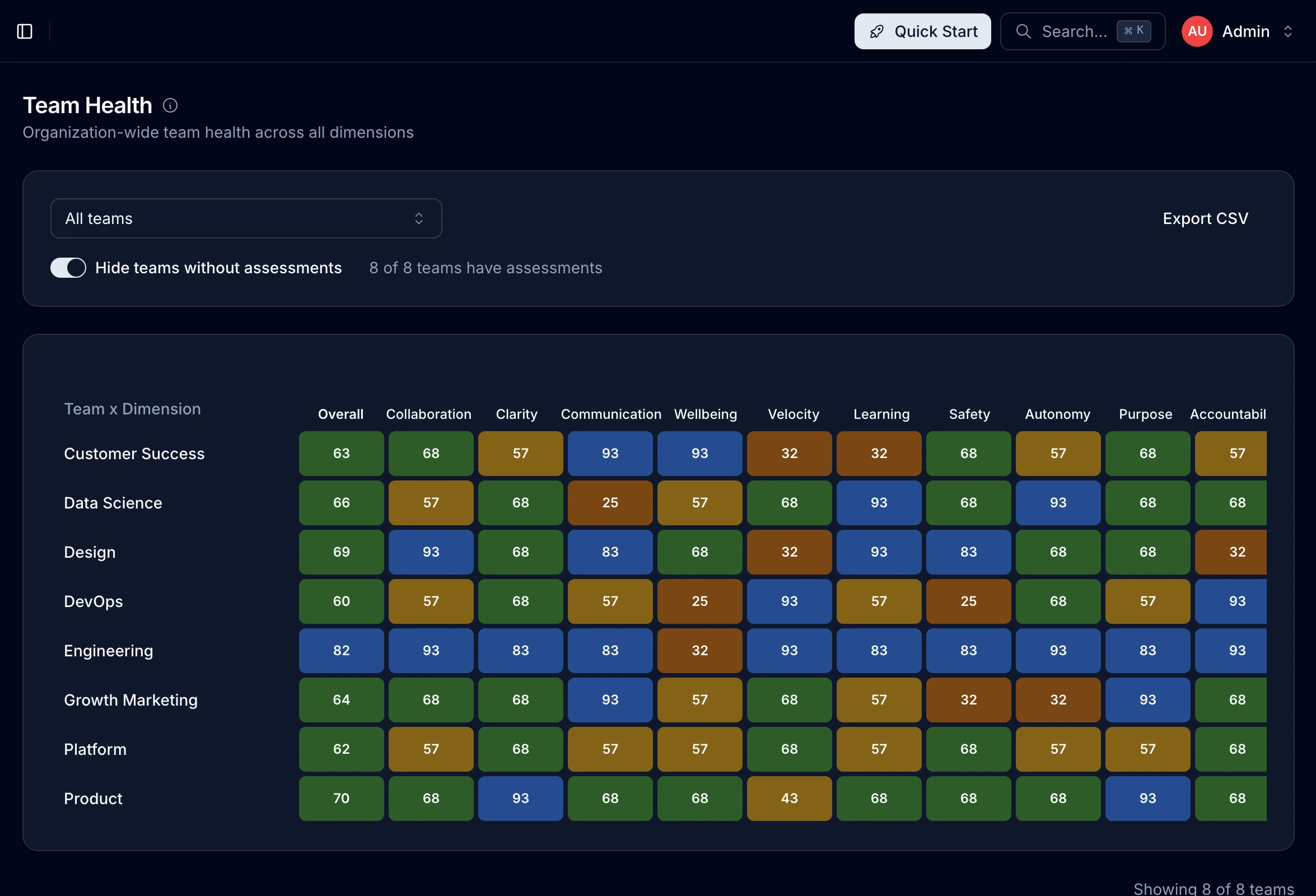
The era of measuring individuals and hoping teams work is over
Organizations invest heavily in individual performance measurement — reviews, competency frameworks, engagement surveys — while the unit that actually delivers results goes unmeasured. McKinsey's Team Effectiveness Index found that trust, communication, and shared decision-making are the top performance drivers. Not individual talent. Not headcount. Team dynamics.
McKinseyMcKinsey's Organizational Health Index — the largest study of its kind — shows healthy organizations deliver 3x shareholder returns, 3.9x employee satisfaction, and 2.7x lower burnout. But "organizational health" isn't abstract — it's the aggregate of team dynamics across every team. You can't improve what you don't measure.
McKinsey Organizational Health IndexIndividual engagement surveys vs. team health scores
| Aspect | Engagement Surveys | Team Health Scores |
|---|---|---|
| What's measured | Individual sentiment — "How happy are you?" | Team dynamics — "How well does this team work together?" |
| Frequency | Annual or quarterly, results weeks later | Weekly assessments, real-time heatmap dashboard |
| Granularity | Organization-wide averages | Ten dimensions per team, sortable across all teams |
| Actionability | "Engagement is down 3%" — now what? | "Team X has declining Safety scores" — here's what to do |
| Research basis | Generic satisfaction questions | Project Aristotle, Edmondson, SDT, Spotify Health Check |
| What it misses | A team of engaged individuals can still have broken dynamics | Measures the dynamics between people, not just how each person feels |
| Response time | Wait a year to see if changes helped | Track intervention impact week over week |
Ten dimensions. Every team. Every week.
Mistvine operationalizes what Project Aristotle, Edmondson, and Pentland proved: team dynamics are measurable and improvable. Anonymous weekly assessments across ten research-backed dimensions flow into an organization-wide heatmap. Teams self-organize around the data. Leaders intervene only where the scores say it matters.
Ten Research-Backed Dimensions
Collaboration, Clarity, Communication, Wellbeing, Velocity, Learning, Safety, Autonomy, Purpose, and Accountability. Each maps to validated frameworks from Google, Edmondson, Hackman, and SDT. Each rated 1–5. The full picture of how a team works together.
Learn moreOrganization-Wide Heatmap
Every team, every dimension, one matrix. Color intensity shows health at a glance. Sort by any dimension to find where dynamics are breaking down. Scan your entire organization in seconds.
Learn moreAnonymous by Design
85% of employees withhold information from leaders. Anonymity fixes that. Team members rate honestly because they know scores are aggregated — never traced back. The data is only useful if it's honest.
Learn moreSelf-Correcting Teams
High-performing teams don't wait for intervention — they adapt. Shared health scores give teams the signal to self-organize. When a team sees their own Clarity dropping, they fix it before anyone has to ask.
Learn moreRoot Cause Intelligence
Low Safety suppresses every other dimension — people won't flag problems if they don't feel safe. Low Clarity drags Velocity and Collaboration. Mistvine surfaces these interconnections so you fix root causes, not symptoms.
Learn moreCommon questions about team health scores
What are team health scores?
Team health scores measure how well a team works together across ten evidence-backed dimensions: Collaboration, Clarity, Communication, Wellbeing, Velocity, Learning, Safety, Autonomy, Purpose, and Accountability. Each dimension is rated 1–5 by team members in anonymous weekly assessments. The aggregated scores give a clear, actionable picture of team dynamics — not individual sentiment.
Why measure team dynamics instead of individual engagement?
Because team dynamics predict performance more than individual talent does. Google's Project Aristotle found that who was on the team didn't matter — how they worked together did. MIT's Alex Pentland proved that communication patterns alone predicted 35% of the variation in team performance. A team of individually engaged people can still have broken dynamics. Team health scores catch what engagement surveys miss.
How are the ten dimensions chosen?
The dimensions are grounded in validated research frameworks: Google's Project Aristotle (180+ teams), Amy Edmondson's psychological safety research, Hackman's team effectiveness conditions, Self-Determination Theory (autonomy, competence, relatedness), Salas et al.'s "Big Five" in teamwork, and the Spotify Squad Health Check model. Each dimension maps to at least one peer-reviewed framework.
Are assessments really anonymous?
Yes. Team members submit assessments anonymously — team leads see aggregated scores per dimension, never individual responses. This is critical: research shows 85% of employees withhold information when they fear consequences. The data is only useful if it's honest, and honesty requires genuine anonymity.
How do team health scores help self-organizing teams?
Self-organizing teams need shared signal to self-correct. When a team can see their own Clarity or Collaboration scores declining, they can address it themselves — without waiting for top-down intervention. The scores create a feedback loop: the team sees the data, discusses it, takes action, and watches whether scores improve. High-performing teams use this to continuously tune their own dynamics.
What should I do when a team has low scores?
First, identify the weakest dimension — it tells you where to focus. A team with low Safety needs a very different response than one with low Velocity. Consider the interconnections: low Safety often suppresses all other dimensions, so it may be the root cause behind multiple low scores. Talk to the team lead, consider recent context (new members, project stress, reorganization), and track whether scores improve over the following weeks.
Can team health scores predict attrition?
Yes. Research shows psychological safety erodes over time without active intervention, and declining scores in Safety, Wellbeing, and Purpose are leading indicators of turnover. 42% of turnover is preventable — but only if the organization sees it coming. Weekly health scores give you the advance warning that annual surveys can't.
Ready to Measure What Actually Predicts Performance?
Start your 14-day free trial. No credit card required.
Start Your 14-Day Free Trial No credit card required