
Your Strategy Isn't Failing.
Your Execution Is.
Most strategies are sound. The problem is the gap between the boardroom and the people doing the work. OKRs with wave-based planning cycles close that gap — connecting every team to organizational priorities with built-in accountability and honest sentiment signals.
OKRs (Objectives and Key Results) are a goal-setting framework that pairs one qualitative objective with three to five measurable key results, run on short cycles rather than annual plans. They work because they make strategy visible — only 5% of employees can articulate their company's strategy by default (Kaplan & Norton, Harvard Business Review), and 67% of well-formulated strategies fail because of execution, not strategy itself (Strategy Execution Research). OKRs close that gap by cascading objectives from organization to team to individual, scoring confidence on a 0.0–1.0 scale, and treating consistent 1.0 scores as a sign of sandbagging. Modern OKR practice replaces rigid quarters with shorter "wave" cycles of four to twelve weeks, attaches anonymous weekly sentiment to each objective so progress reflects how the team actually feels, and treats key results as outcomes (revenue, retention, latency) rather than activity counts (blog posts, meetings).
Goals set once a year die within weeks
Annual goal-setting creates a fiction of alignment. The data shows that most organizations set goals, forget them, and then wonder why strategy fails.
What the research says
Alignment Drives Performance
When employees can see how their work connects to organizational objectives, engagement doesn't just improve — it transforms. The problem with annual goals isn't ambition; it's that two-thirds of senior managers can't even name their firm's top three priorities. OKRs make priorities visible and measurable.
Shorter Cycles, Better Outcomes
Organizations that review goals quarterly or more often dramatically outperform annual planners. Wave-based cycles (2–6 weeks) take this further — short enough to maintain urgency, long enough to deliver meaningful work. When priorities shift, teams adapt in weeks, not quarters.
Team Buy-In Over Top-Down Mandates
Google sets ~60% of its goals bottom-up — teams closest to the work define how they'll contribute to company objectives. Research consistently shows that participative goal-setting produces psychological ownership, not just compliance. When people help shape objectives, they fight for them.
Wave Objectives
Org-Wide Goals with Real-Time Progress
Define company-level objectives for each wave cycle — track time remaining, team alignment, and key result progress across the entire organization from a single dashboard.
See this feature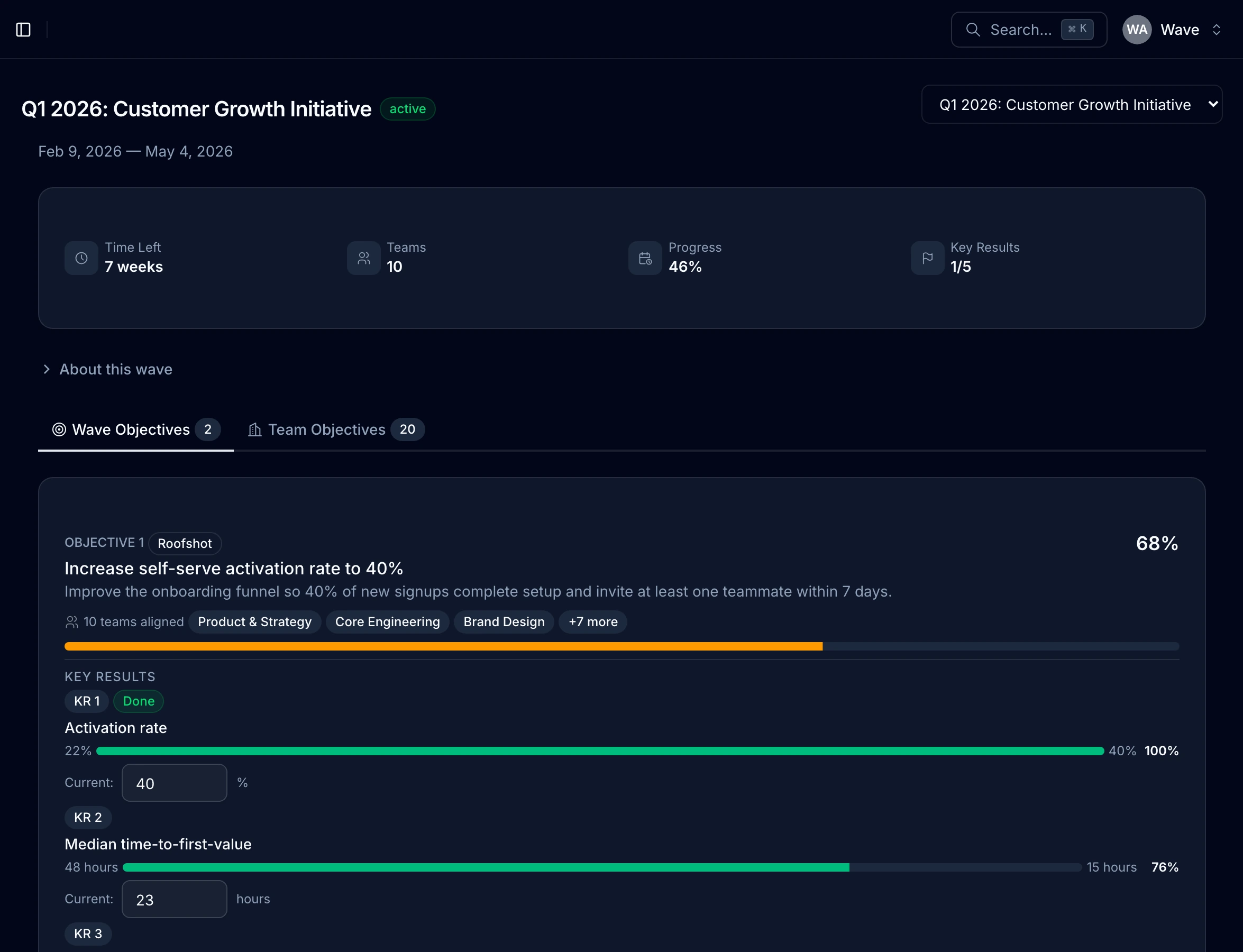
Team Objectives
Every Team Aligned to the Mission
Teams set their own objectives that ladder up to wave goals. See every team's score at a glance, drill into key results, and spot which groups need support before the cycle ends.
See this feature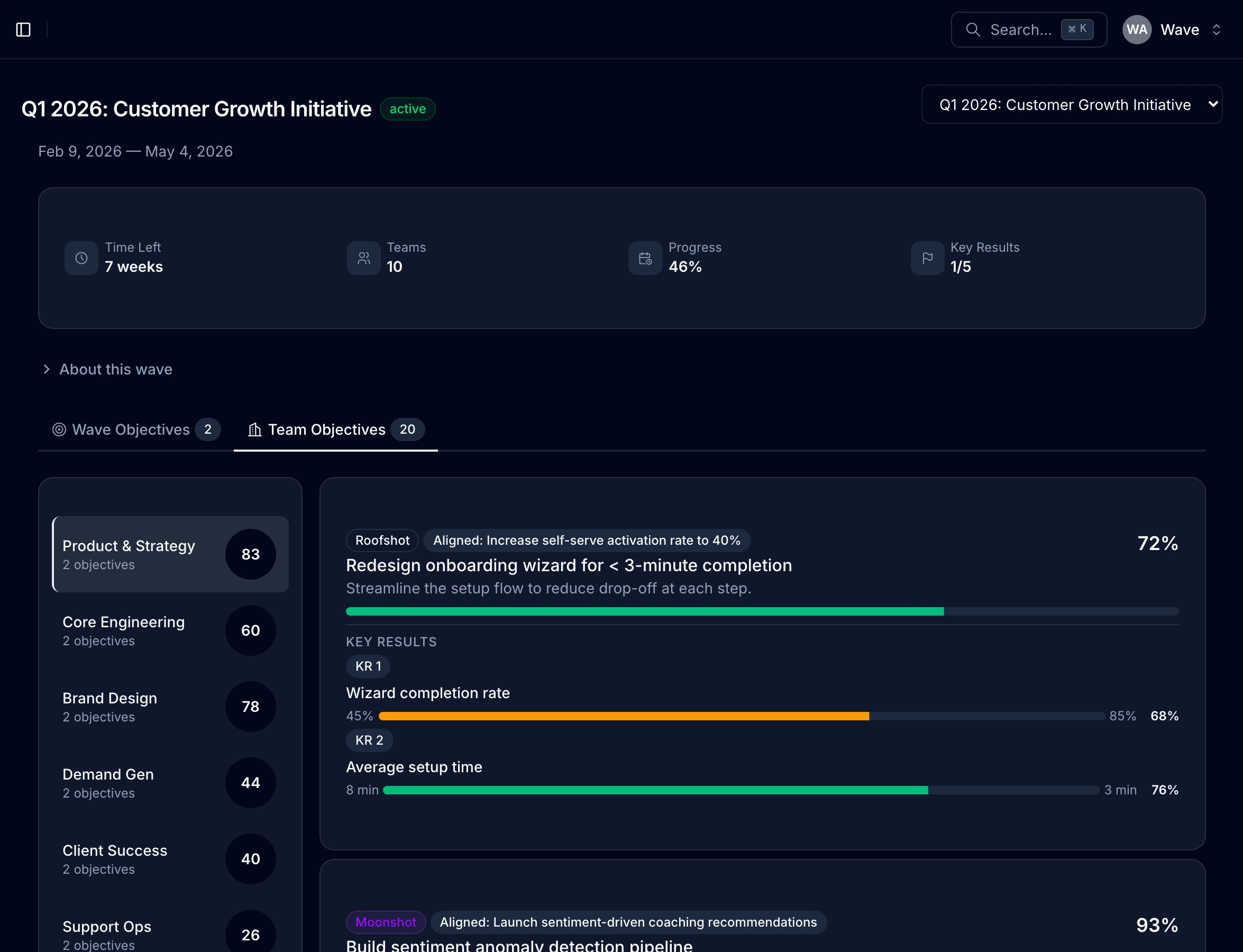
Individual OKRs
Personal Goals That Connect to the Bigger Picture
Every employee sets personal development objectives with measurable key results — baseline, current, and target values make progress concrete, not subjective.
See this feature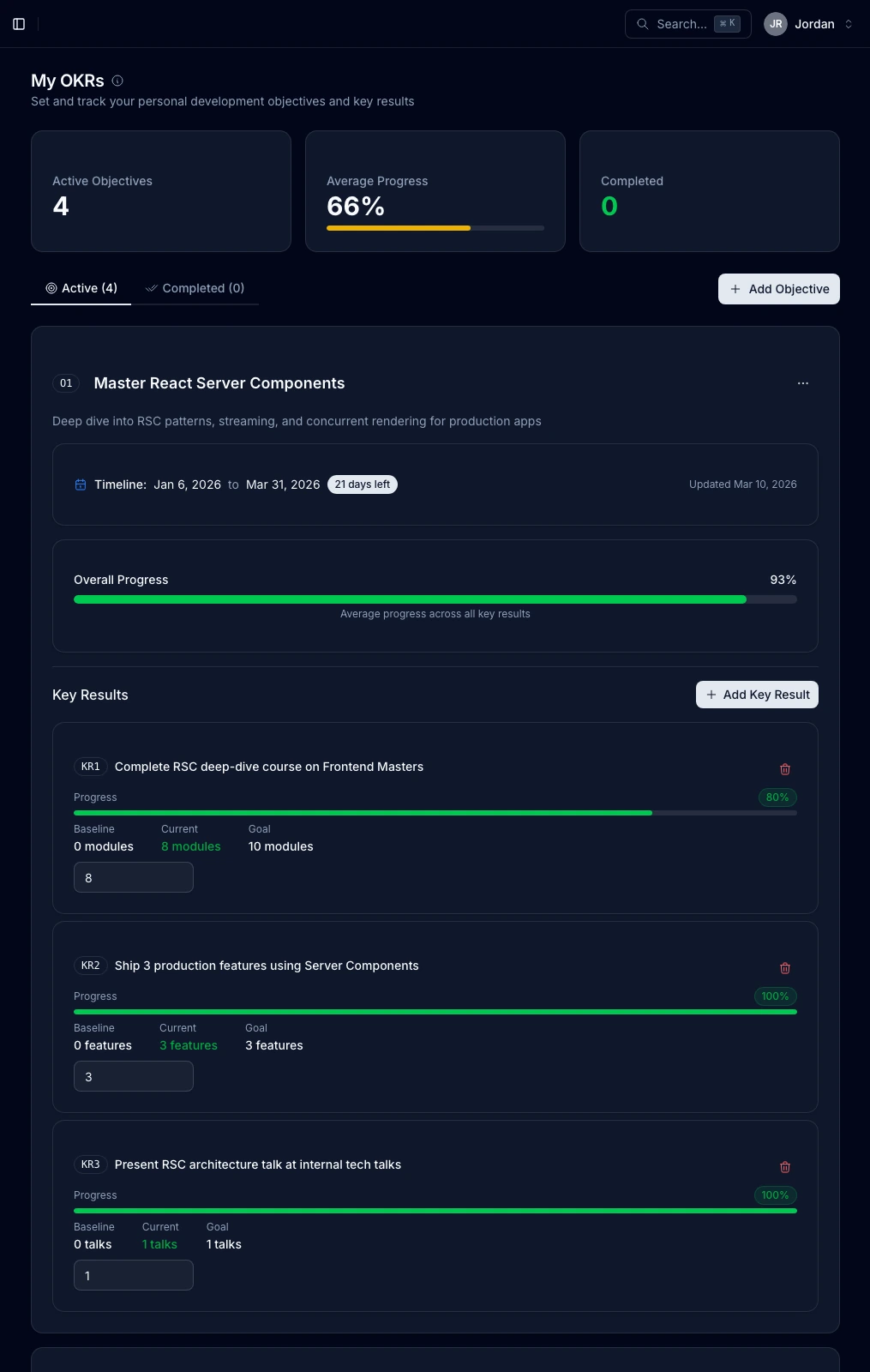
Agile organizations are pulling ahead
McKinsey's research across agile transformations shows 20–30% improvement in financial performance, 30–50% in operational performance, and 20–30 point gains in employee engagement. The common thread: shorter planning cycles, cross-functional teams, and transparent goals.
McKinseyThe shift from annual to continuous isn't a trend — it's a structural change. Organizations that move to wave-based OKRs gain a compounding advantage: every cycle produces data, alignment, and momentum that annual planners can't match.
Deloitte Human Capital TrendsAnnual goals vs. wave-based OKRs
| Aspect | Annual Goal-Setting | Wave-Based OKRs |
|---|---|---|
| Planning cadence | Once a year, then forgotten | 2–6 week waves with continuous tracking |
| Strategy visibility | 5% of employees understand strategy | Every team sees how their objectives connect |
| Goal tracking | 80% of organizations don't track goals | Key results with measurable progress |
| Adaptability | Locked in for 12 months | Reprioritize every wave cycle |
| Team confidence | No signal until goals miss | Weekly anonymous sentiment voting |
| Cross-team alignment | Siloed department goals | Shared objectives with boost requests |
| Accountability | Year-end review of stale goals | Continuous progress and sentiment data |
OKRs with built-in honesty signals
Most OKR tools track progress. Mistvine tracks how your teams actually feel about every objective — so you know where confidence is dropping before goals miss.
Wave-Based Cycles
Time-boxed 2–6 week cycles. Teams align to organization objectives, execute with autonomy, and reflect. No more annual plans that go stale by February.
Learn morePer-Objective Sentiment Voting
Every week, team members anonymously rate confidence on each objective (1–5). Heat maps surface where sentiment is dropping before it becomes a crisis.
Learn moreCross-Team Boost Requests
Teams post what help they need. Other teams offer support. Transparent, cross-functional collaboration built into the OKR workflow.
Learn moreIndividual Development Goals
Personal objectives for skills, career, learning, and wellbeing — tracked alongside team OKRs so growth isn't sacrificed for delivery.
Learn more4-Tier Cascading Principles
Org → practice → team → individual behavioral standards. Every objective is grounded in what "good" looks like at every level.
Learn moreCommon questions about okrs & wave-based planning
What are OKRs and how do they work?
OKRs (Objectives and Key Results) are a goal-setting framework where teams define qualitative Objectives (what we want to achieve) and measurable Key Results (how we'll know we achieved it). Popularized by Intel and Google, OKRs create alignment by making goals transparent and trackable across the organization.
Why do annual goals fail?
Annual goals fail because business priorities change faster than once a year. Research shows 80% of organizations don't track their goals after setting them, only 6% regularly revisit them, and 67% of well-formulated strategies fail in execution. By the time annual goals are reviewed, the market has moved on.
What is wave-based planning?
Wave-based planning replaces rigid annual or quarterly cycles with flexible 2–6 week "waves." Each wave has organization-level objectives that teams align to with their own key results. At the end of each wave, teams reflect, learn, and reset — keeping strategy execution tight and adaptive.
How does sentiment voting improve OKRs?
Traditional OKR tools only track progress percentages, which can be gamed or misleading. Sentiment voting asks team members to anonymously rate their confidence in each objective weekly. This surfaces hidden blockers, misaligned expectations, and morale issues before they derail goals — giving managers actionable signals that progress bars alone can't provide.
How are Mistvine waves different from quarterly OKRs?
Quarterly OKRs are better than annual goals, but 13 weeks is still long enough for priorities to drift. Mistvine waves are 2–6 weeks — customizable to your organization's rhythm. Each wave includes per-objective sentiment voting, cross-team boost requests, and key result tracking. Shorter cycles mean faster feedback loops and more opportunities to adapt.
What companies use OKRs successfully?
Google, Intel, LinkedIn, Netflix, Spotify, and the Gates Foundation all use OKRs. Google has used quarterly OKRs since 1999, with every employee's OKRs visible company-wide. Larry Page credited OKRs with helping Google achieve "10x growth." The framework works across industries — from tech to nonprofits — because it solves a universal problem: connecting strategy to execution.
Do OKRs replace performance reviews?
OKRs measure team and organizational progress — they're not designed for individual performance evaluation. Google explicitly separates OKR scores from performance ratings. Mistvine uses OKRs alongside continuous 360 feedback and manager assessments, so you get both strategic alignment and individual growth signals without conflating them.
Ready to Close the Strategy-Execution Gap?
Start your 14-day free trial. No credit card required.
Start Your 14-Day Free Trial No credit card required