
Career Growth Shouldn't Be a Guessing Game.
At Most Companies, It Is.
Lack of career development has been the #1 reason employees quit for more than ten consecutive years. Not pay. Not leadership. Not culture. People leave because they can't see the path forward. Growth frameworks make the path visible — practice-specific levels with clear competency expectations that every member can see, track, and grow toward.
A growth framework is a published, practice-specific competency ladder that defines what each level (e.g. Associate → Mid → Senior → Staff → Principal Engineer) actually requires — the behaviors, deliverables, and scope expected at each step, written down so people can self-assess against them. Frameworks matter because lack of career development has been the #1 reason employees quit for more than ten consecutive years (above pay, leadership, or culture), and only 46% of employees today feel clear about what is expected of them at work — down from 56% in 2020 (Gallup). When the path is invisible, people guess, get frustrated, and leave. Good frameworks are practice-specific (engineers and designers need different ladders), inheritance-based (Senior includes everything from Mid), example-rich (concrete behaviors not vague competencies), and observable — peers and managers can rate against them with continuous evidence rather than one annual ceremony.
People can't grow when they can't see the path
At most organizations, career progression is invisible. "Senior" means something different in every team. Promotion criteria live in someone's head. People don't know what's expected at their current level, let alone the next one. So they leave — and the cost compounds.
Why clear expectations are the foundation of everything
Gallup's Q12 research across 112,312 business units found that clarity of expectations is the single most foundational driver of engagement — everything else builds on it. When people know exactly what's expected, they grow. When they don't, they disengage.
The research converges from multiple directions. Locke & Latham's goal-setting theory (35 years, hundreds of studies) proves that specific goals drive higher performance than vague aspirations — a competency matrix converts "I want to grow" into clear targets. Teresa Amabile's progress principle (12,000 diary entries) shows that visible progress on meaningful work is the single strongest motivator — every competency leveled up is a small win that fuels momentum. Self-Determination Theory identifies competence as a basic psychological need — when people feel they're mastering their craft, engagement and performance follow. And Wenger's communities of practice research shows that domain-organized groups accelerate skill development and reduce learning curves.
What changes when career growth is visible and practice-led
People See Exactly Where They Stand — And What Comes Next
A competency matrix makes expectations concrete. Members can see every competency, their current proficiency, and what the next level requires — Developing, Proficient, or Advanced. No ambiguity. No politics. Career progression becomes a visible, self-directed path instead of a conversation you have to ask for.
Domain Experts Define What Excellence Looks Like
An engineer and a designer shouldn't be on the same career ladder. Practice leads — senior practitioners in each discipline — define the levels and competency standards for their craft. They know what "senior" actually means because they've done the work. Spotify's Chapter Lead model, Wenger's communities of practice, and Deloitte's 2025 research all confirm: career development works best when led by someone who deeply understands the domain.
Every Skill Gained Is a Visible Win
Amabile's progress principle — drawn from 12,000 diary entries — shows that making progress on meaningful work is the single most powerful motivator. Competency frameworks create a visible progress trail. Every proficiency leveled up, every competency demonstrated is a small win that compounds into mastery. People don't just grow faster — they feel it happening.
Practice Leveling
Craft the Ladder Your Practice Actually Needs
Define levels, assign competencies, and let each rung inherit skills from below — so expectations compound naturally and no one has to guess what "senior" really means.
See this feature
Practice Levels
Clear Progression from Day One
Each practice defines a leveling ladder — from Associate to Principal — with competencies that accumulate as people grow. Everyone sees exactly where they stand and what mastery looks like at the next level.
See this feature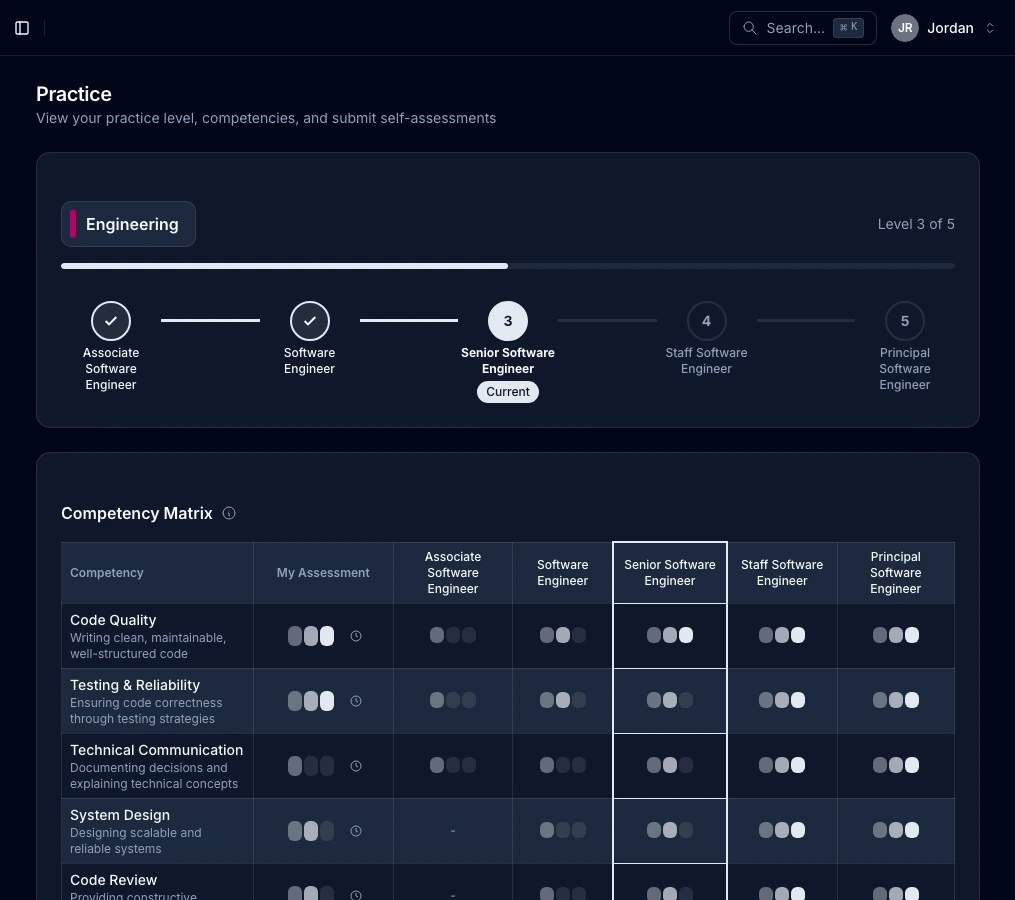
The organizations defining career paths by competency are winning the talent war
Deloitte's research is conclusive: skills-based organizations are 107% more likely to place talent effectively, 98% more likely to retain high performers, and 79% more likely to provide a positive workforce experience. Yet 93% of executives say this shift is important and only 20% feel ready. The gap isn't intent — it's having a system that makes competency visible and progression structured.
DeloitteLinkedIn's data shows employees stay 41% longer at companies that hire from within, and promoted employees are 55% more likely to stay for three years. But internal mobility requires a shared language for competency — a way to know who is ready for what. Practice-specific leveling with clear competency expectations creates that language. It turns career growth from a closed-door conversation into a visible, self-directed path.
LinkedInInvisible career paths vs. practice-led growth frameworks
| Aspect | Invisible Career Paths | Growth Frameworks |
|---|---|---|
| What "senior" means | Undefined — different in every team, depends who you ask | Explicit competency matrix with proficiency expectations at every level |
| How people know what to work on | Ask your lead — if they know, and if they remember to tell you | Every competency, every expectation, every level visible to every member |
| Who defines the standards | Generic HR ladders that mean different things in different disciplines | Practice leads — domain experts who've done the work — define what excellence looks like |
| Career progression | Wait for someone above you to notice you're ready | Self-assess against clear criteria, track your own growth, signal when you're ready |
| Promotion criteria | Unwritten rules and political navigation | Observable competencies with defined proficiency thresholds |
| Development culture | Growth is a side conversation — if it happens at all | Apprenticeship culture where practice members learn from each other continuously |
| Progress visibility | No way to see how far you've come or how far you have to go | Assessment history tracks every competency gained over time |
Practice-specific levels. Clear competencies. Visible progress.
Mistvine turns career growth from a guessing game into a system. Practice leads define levels and competency standards for their discipline. Members see exactly what's expected at every level. Self-assessment and lead assessment create a multi-perspective view. Progress is tracked over time, not recalled from memory.
Practice-Specific Leveling
Every practice defines its own career levels — Associate through Principal, or whatever fits the discipline. An engineer and a designer aren't on the same ladder because "senior" means different things in different crafts. Practice leads own the standards for their domain.
Learn moreCompetency Matrix
Each level has explicit proficiency expectations across every competency — Developing, Proficient, or Advanced. Higher levels inherit from lower ones, creating progressive difficulty. Members can see exactly what's expected now and what the next level requires.
Learn moreSelf-Assessment Against Clear Criteria
Members rate themselves on every competency against the same matrix their practice lead uses. No guessing what the bar is. Self-assessment becomes a development tool — it shows you your gaps and gives you a concrete growth plan.
Learn morePractice Lead Assessment & Recommendation
Practice leads — senior practitioners who understand the craft — provide their own competency assessment and recommend level changes when members are ready. Domain expertise evaluates domain skill. People coaches approve with full data.
Learn moreVisible Progress Over Time
Every competency assessment is tracked historically. Members and leads can see growth trajectories — not just where someone is, but how they got there. Every proficiency gained is a small win that compounds into mastery.
Learn moreCommon questions about growth frameworks
What is a growth framework?
A growth framework is a structured system that defines career levels within a discipline, the competencies required at each level, and the process for progression. In Mistvine, each practice (engineering, design, product, etc.) defines its own levels and competency matrix. Members can see exactly what's expected at their current level and what the next level requires — no guessing, no politics.
Why practice-specific levels instead of one company-wide ladder?
"Senior" means something fundamentally different for an engineer vs. a designer vs. a product lead. Practice-specific leveling lets each discipline define what excellence looks like in their craft. Practice leads — experienced practitioners in that domain — own the competency standards, because career development works best when led by someone who deeply understands the work.
How does the competency matrix work?
Each practice has a set of competencies (e.g., System Design, Code Quality, Mentoring). Each competency has a proficiency expectation at each level — Developing (1), Proficient (2), or Advanced (3). Higher levels inherit expectations from lower ones, creating progressive difficulty. Members can see the entire matrix, know exactly where they stand, and identify exactly what to work on next.
How do members track their growth?
Members self-assess their proficiency on every competency in their practice. These assessments are tracked over time, creating a visible growth trajectory. When members believe they're ready for the next level, they signal readiness. Practice leads review assessments, provide their own evaluation, and recommend level changes when the data supports it.
What role do practice leads play?
Practice leads are senior practitioners who own the career framework for their discipline. They define levels, set competency expectations, assess members' skills with domain expertise, and recommend level changes. They're the equivalent of Spotify's Chapter Leads — experienced professionals who ensure career development is guided by someone who genuinely understands the craft.
How do practice leads differ from team leads?
Team leads focus on delivery — objectives, collaboration, and team dynamics. Practice leads focus on craft — competency development, leveling standards, and professional growth within a specific discipline. A member belongs to one practice and can be on multiple teams. The practice lead assesses whether someone's craft skills are at a senior level; the team lead assesses how they're contributing to current team objectives.
What role do people coaches play?
People coaches approve level changes recommended by practice leads. They see the full picture: the member's self-assessment, the practice lead's assessment, competency gaps relative to the target level, and the recommendation notes. This ensures level changes are data-informed and calibrated across the organization.
How does this help with retention?
Lack of career development has been the #1 reason employees quit for over a decade (Work Institute). LinkedIn's data shows 94% would stay longer with career investment, and employees confident in their growth path are 3.3x more likely to stay. Growth frameworks make career progression visible, self-directed, and continuous — addressing the exact problem that drives most attrition.
Ready to Make Career Growth Visible?
Start your 14-day free trial. No credit card required.
Start Your 14-Day Free Trial No credit card required