
Micromanagement Kills Teams.
Chaos Without Direction Kills Companies.
The highest-performing organizations solve both problems at once. They give teams strategic clarity about what matters and the freedom to decide how to get there. Spotify calls it aligned autonomy. Mistvine makes it operational with wave-based OKRs, anonymous sentiment voting, and self-organizing collaboration.
Aligned autonomy is an operating model — popularized by Spotify and adopted by Netflix, Shopify, and most modern PLG companies — in which leadership sets explicit strategic direction (the "what" and the "why") and teams own the "how" with full execution freedom. The two failure modes it solves are well-documented: chaos without direction, where autonomous teams build the wrong things and step on each other; and micromanagement, which 79% of employees have experienced and 36% have quit over (Trinity Solutions). Aligned autonomy works when leadership invests in clarity (written objectives, transparent priorities, visible cross-team dependencies) and pulls back from execution decisions, even uncomfortable ones. Operationally it usually means short strategic cycles (quarterly OKRs or wave-based equivalents), team-owned key results, regular cross-team coordination forums, and feedback loops on whether teams feel they have both clarity and freedom — typically anonymous so the signal is honest.
Control and chaos are both broken
Organizations oscillate between two failure modes: leaders who prescribe every decision (killing ownership) and leaders who set teams free without context (killing alignment). Both produce the same result — disengagement.
What the research says
Autonomous Teams Outperform
McKinsey's research on agile organizations is unambiguous: teams that receive strategic direction and then choose how to execute deliver dramatically better results across every metric. The pattern is consistent — set the destination, let teams chart the route.
High-Performing Teams Have More Autonomy
Deloitte's 2025 research surveyed nearly 1,400 people and found a clear pattern: members of high-performing teams consistently report more autonomy, more empowerment to reshape their roles, and more trust from their leaders. Autonomy isn't a perk — it's a performance characteristic.
Alignment Multiplies Engagement
When employees can see how their work connects to organizational objectives, engagement transforms. But alignment without autonomy is just better-documented micromanagement. The combination — understanding why your work matters and having the freedom to own it — is what produces engagement that actually sticks.
Wave Objectives
Org-Wide Goals with Real-Time Progress
Define company-level objectives for each wave cycle — track time remaining, team alignment, and key result progress across the entire organization from a single dashboard.
See this feature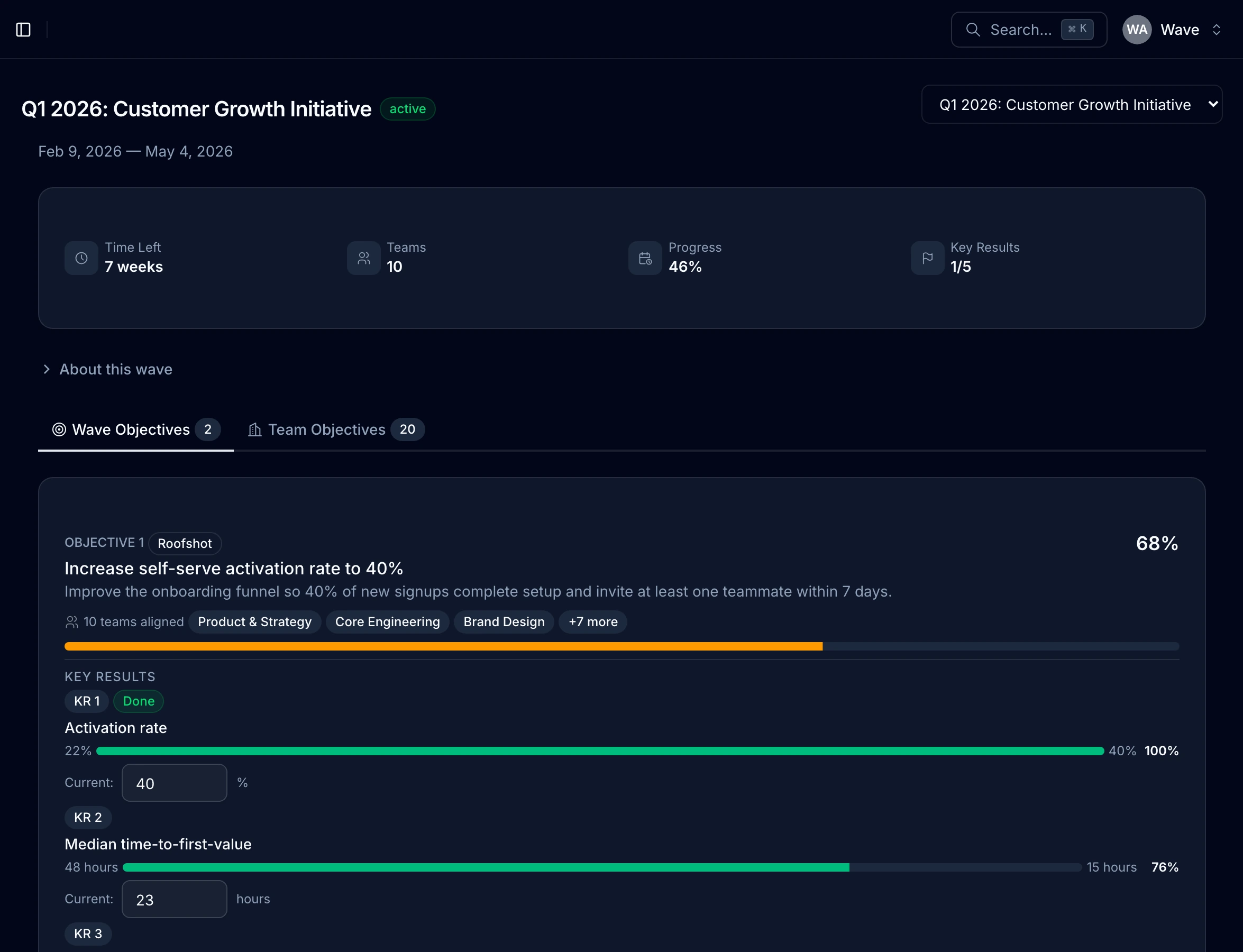
Team Objectives
Every Team Aligned to the Mission
Teams set their own objectives that ladder up to wave goals. See every team's score at a glance, drill into key results, and spot which groups need support before the cycle ends.
See this feature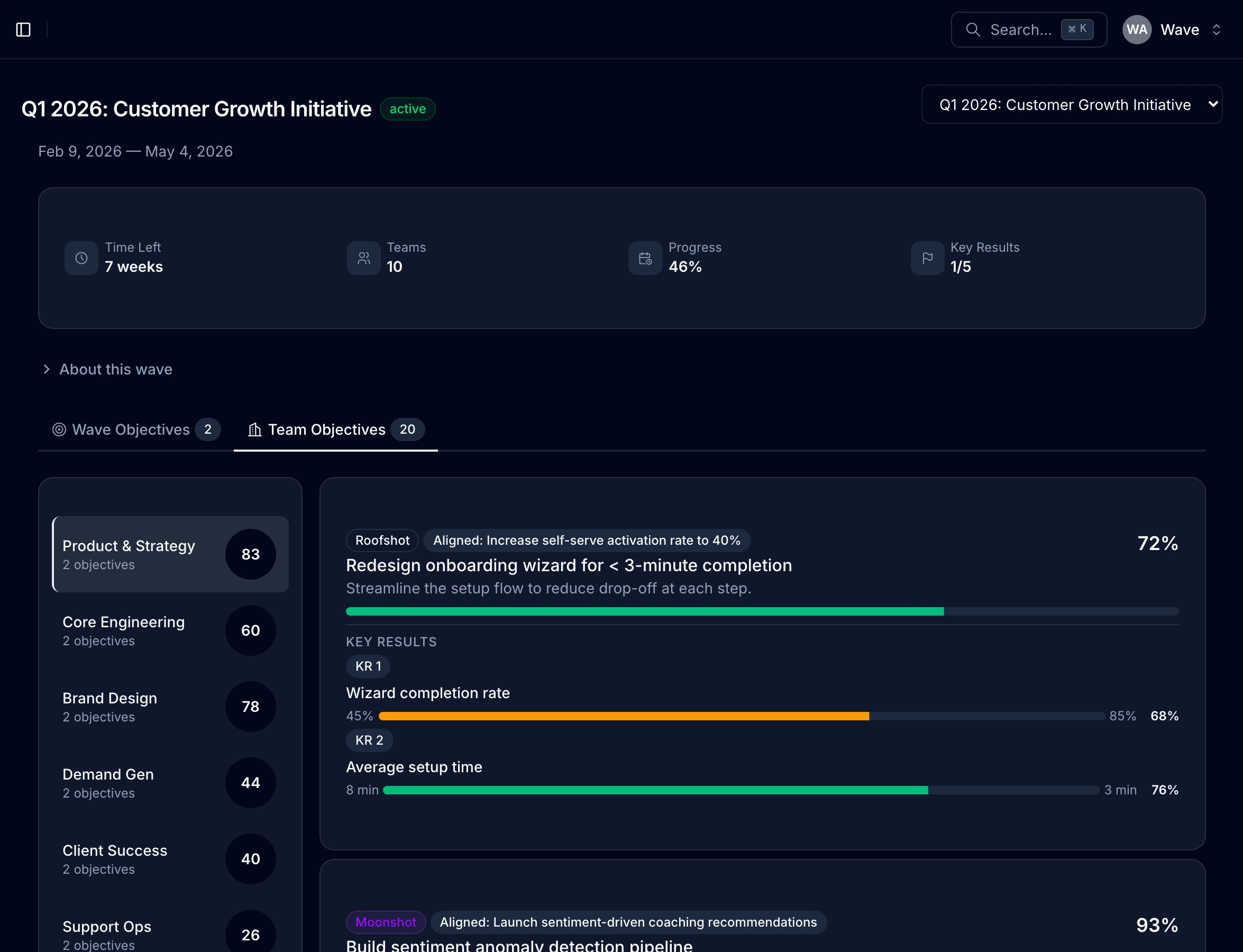
Disengagement is the most expensive problem you're ignoring
Engagement and culture account for 37% of departure reasons. Pay is only 11%. It takes more than a 20% raise to poach an engaged employee — but next to nothing to lose a disengaged one. Aligned autonomy isn't just a management philosophy; it's a retention strategy.
GallupOnly 21% of employees globally are engaged. The organizations that close this gap don't do it with perks — they do it with clarity of purpose, trust in their teams, and systems that make alignment visible and autonomy accountable.
Gallup State of the Global Workplace, 2025Command-and-control vs. aligned autonomy
| Aspect | Command-and-Control | Aligned Autonomy |
|---|---|---|
| Strategy communication | Top-down mandates with prescribed execution | Strategic OKRs cascaded to team objectives with rationale |
| Decision-making | Bottlenecked through management layers | Teams decide how to execute within strategic bounds |
| Visibility into progress | Status meetings and filtered reporting | Anonymous sentiment voting + weekly PPP |
| Cross-team coordination | Leadership assigns resources top-down | Self-organizing boost requests between teams |
| Adaptability | Change requires re-approval up the chain | Teams adapt within wave cycles, reprioritize every 2–6 weeks |
| Trust signal | No signal — managers assume compliance | Weekly anonymous confidence scores on every objective |
| Failure response | Blame and tighter controls | Problems surface in PPP, teams self-organize help via boosts |
Strategy flows down. Honesty flows up. Teams execute.
Aligned autonomy is a principle. Mistvine makes it a system. Organization objectives cascade to team OKRs in wave cycles. Teams execute with freedom. Sentiment voting and PPP give leadership real-time signals without micromanaging. Boost requests let teams self-organize help.
Wave-Based Strategic Alignment
Organization sets 2–5 strategic objectives. Teams create their own objectives with alignment rationale explaining why their work contributes. Leadership sets the what and why. Teams own the how.
Learn moreAnonymous Sentiment Voting
Every week, team members anonymously rate confidence on each objective (1–5). Heat maps surface where sentiment is dropping. Leadership gets honest signals without asking — no meetings, no filtering, no fear.
Learn moreWeekly PPP Check-Ins
Progress, Plans, Problems — submitted weekly, auto-locked for history. The async accountability layer that replaces status meetings. Problems are visible in a matrix view with "only teams with problems" filtering.
Learn moreSelf-Organizing Boost Requests
Teams post what help they need. Other teams volunteer. No top-down resource assignment — just transparent, self-organizing collaboration. Emergent coordination, not bureaucratic routing.
Learn moreAligned Autonomy Scorecard
Free diagnostic measuring your organization across 4 dimensions: Strategic Clarity, Decision Autonomy, Context Flow, and Execution Velocity. Know where you stand before you start.
Learn moreCommon questions about aligned autonomy
What is aligned autonomy?
Aligned autonomy is a management principle where leadership provides strategic clarity (what needs to happen and why) while teams have the freedom to decide how to execute. Popularized by Spotify's Henrik Kniberg, it sits in the sweet spot between micromanagement (high alignment, low autonomy) and chaos (low alignment, high autonomy).
How is aligned autonomy different from just "empowering teams"?
Empowerment without alignment is chaos — teams work hard on things that don't matter. Aligned autonomy has two parts: strategic clarity (every team understands how their objectives connect to organization goals) and execution freedom (teams choose how to achieve those objectives). Mistvine operationalizes this with wave-based OKRs where teams create objectives with explicit alignment rationale.
How do waves enable aligned autonomy?
Waves are time-boxed cycles (2–6 weeks) where the organization sets strategic objectives and teams create their own aligned objectives with key results. Teams explain how their work contributes to the strategic goal, then execute with full autonomy. At the end of each wave, teams reflect and reset. This creates a rhythm of alignment → execution → learning that repeats continuously.
How does sentiment voting prevent micromanagement?
Sentiment voting gives leadership visibility into team confidence without requiring status meetings or check-ins. Every week, team members anonymously rate each objective from 1 (Struggling) to 5 (Exceeding). Heat maps show where confidence is dropping. Leaders get the signal they need to offer help — not to take control. The anonymity ensures honesty; the async format respects team focus time.
What companies practice aligned autonomy?
Spotify pioneered the model with autonomous squads aligned through missions and OKRs. Netflix practices "context not control" — sharing strategy broadly so employees make informed decisions. Google uses public OKRs with ~60% of goals set bottom-up. Amazon uses two-pizza teams with single-threaded ownership. The pattern is consistent: strategic clarity + team freedom = better outcomes.
What is the Aligned Autonomy Scorecard?
It's a free diagnostic tool that measures your organization across four dimensions: Strategic Clarity (do teams understand the why), Decision Autonomy (can teams act without approval), Context Flow (do teams understand cross-team impact), and Execution Velocity (can teams move quickly). Your score places you on a spectrum from Directive (leadership directs, teams execute) to Autonomous (teams execute with speed and ownership).
Can aligned autonomy work in traditional/hierarchical organizations?
Yes — aligned autonomy is a spectrum, not a binary switch. You don't need to become Spotify overnight. Start with one wave cycle: set 2–3 strategic objectives, let teams create aligned objectives, use sentiment voting to monitor confidence, and use PPP for async accountability. Most organizations see the pattern click within one or two cycles. The Scorecard can help identify where to focus first.
Ready to Trust Your Teams With Strategy?
Start your 14-day free trial. No credit card required.
Start Your 14-Day Free Trial No credit card required