Annual Reviews Are Broken.
The Research Proves It.
Decades of research confirm what every employee already knows: annual performance reviews don't work. The evidence points overwhelmingly toward continuous feedback as the model that actually drives performance, retention, and growth.
Continuous performance management replaces the annual review with frequent, lightweight feedback throughout the year — weekly check-ins, anonymous sentiment, post-project notes, peer comments, and structured 1:1s — so signal is fresh, recency bias is reduced, and behavioral change can actually compound. The evidence is overwhelming: 82% of HR leaders say their current performance system fails to meet objectives (Gartner), only 14% of employees say annual reviews motivate them (Gallup), and 2% of CHROs believe their PM system inspires improvement. Continuous models drive 39% higher talent attraction and sustained engagement above 80% in companies that adopt them. Done well, continuous feedback is anchored to specific behavioral principles (not vague traits), psychologically safe (anonymous where it counts), and tied to action — coaching topics, growth goals, principle ratings — rather than collected and filed. It fails when it becomes constant evaluation pressure or one-way critique with no upward channel.
The numbers tell the story
Across industries and company sizes, the data is consistent: traditional performance reviews fail employees and organizations alike.
Your brain treats reviews like threats
Research shows performance evaluations trigger the same neural threat response as physical danger — impairing the very learning they're meant to inspire.
Performance ratings threaten our sense of status — one of the brain's primary social needs (Rock, SCARF Model, 2008). When threatened, cortisol floods the brain, impairing working memory, cognitive flexibility, and the ability to process feedback constructively (Shields et al., 2016). The annual review becomes the worst possible moment to deliver developmental feedback.
What the research says
Real-Time Course Correction
Annual reviews deliver feedback months after the moment has passed. Continuous signals let managers act immediately, turning every week into a coaching opportunity instead of a backward-looking judgment.
Talent Attraction & Retention
Top performers don't wait a year to find out how they're doing. They want growth signals now. Organizations with continuous feedback see measurably higher talent attraction and lower voluntary turnover.
Psychological Safety
People give honest assessments when they know it's safe. Anonymous peer feedback removes the fear of retaliation that plagues annual review cycles, unlocking the candid signals managers actually need.
Cascading Principles
Principles at Every Level
Organization, team, practice, and personal — four tiers of behavioral principles that guide every feedback conversation. Everyone knows what "great" looks like.
See this feature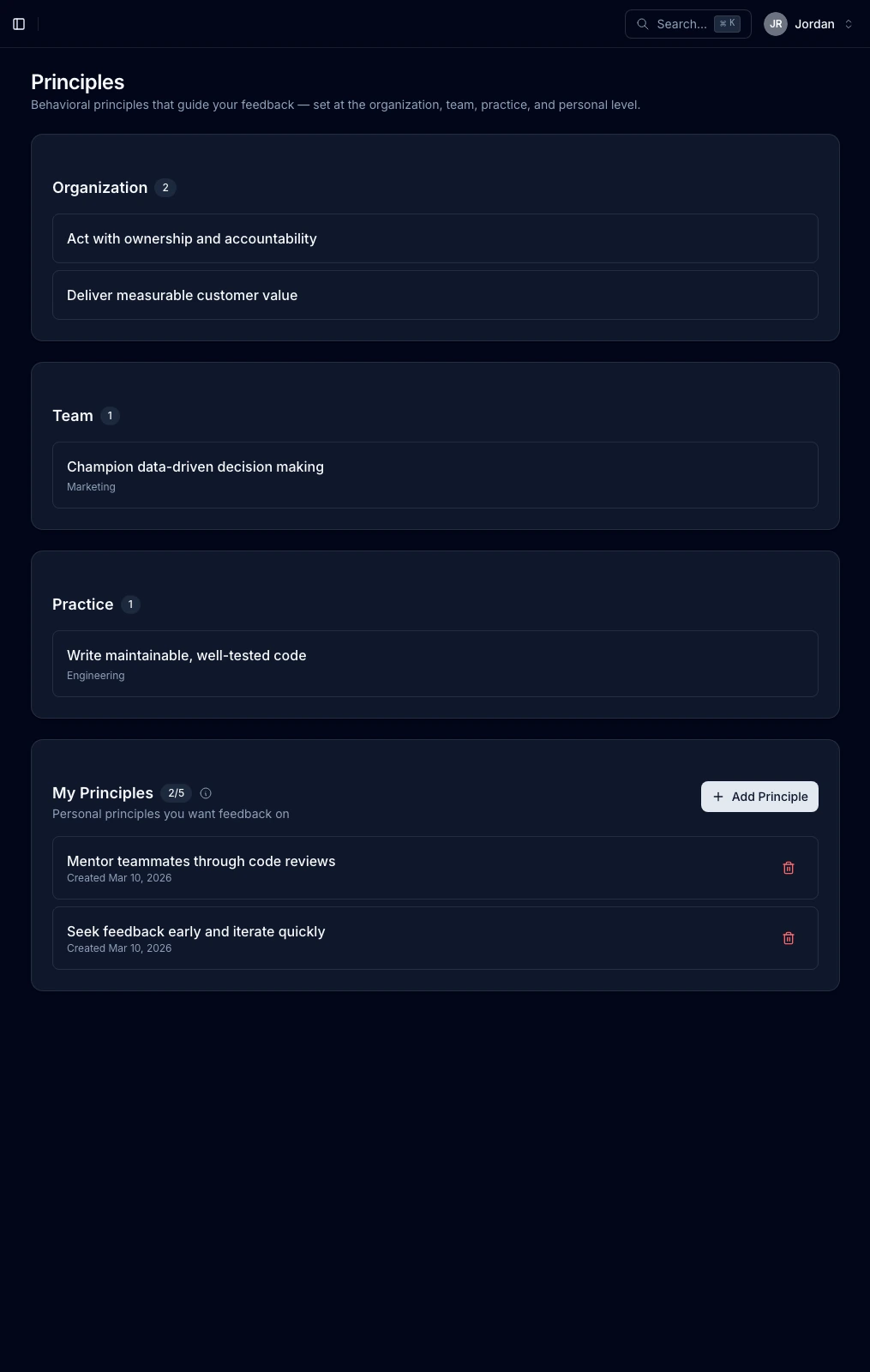
Individual Feedback
See How Your Peers See You
Feedback summary, heatmap, and peer list in one view — employees get continuous, actionable insight into their strengths and growth areas without waiting for an annual review.
See this feature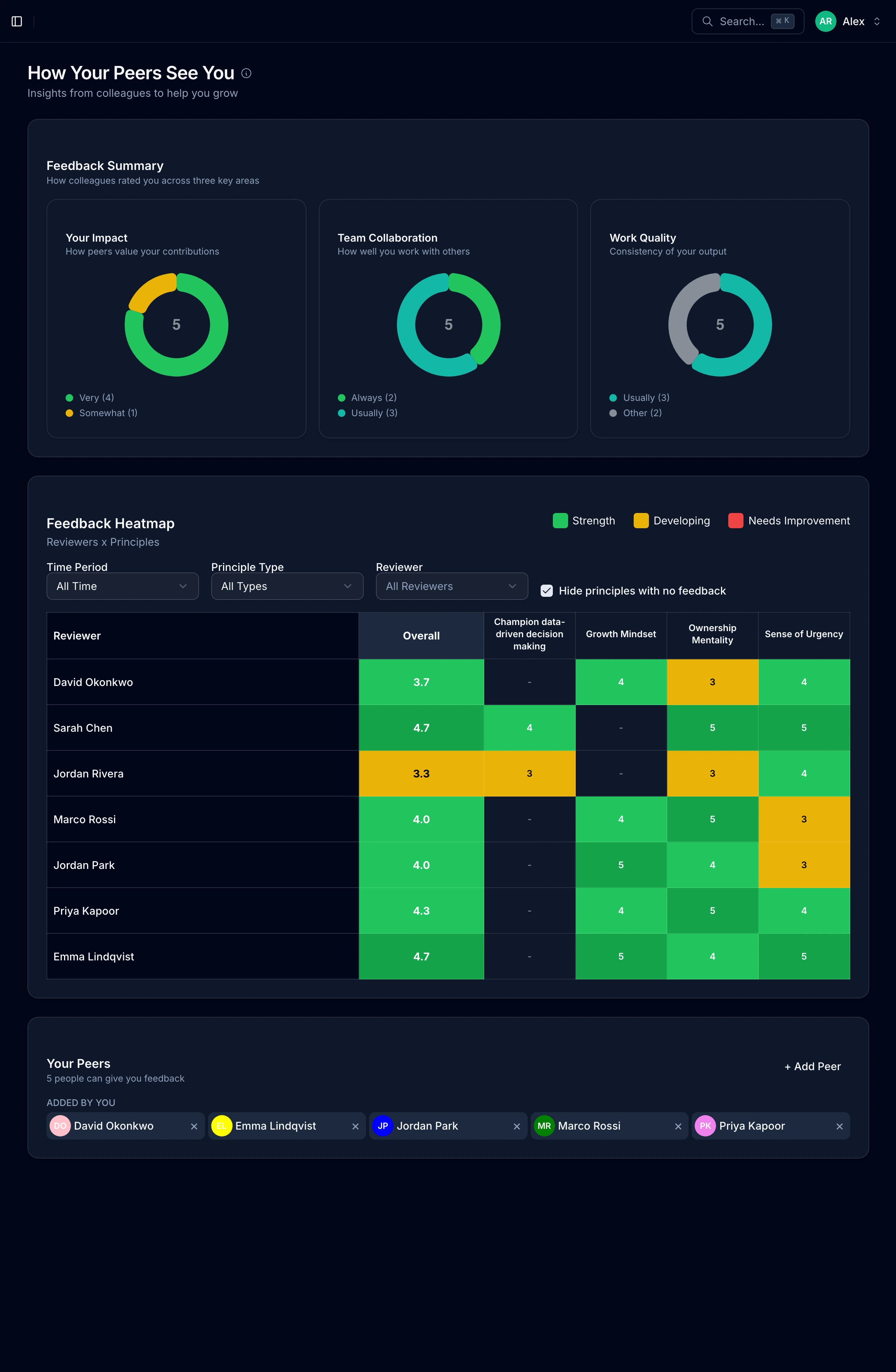
Peer Health Matrix
Spot Relationship Risks Before They Escalate
The peer feedback matrix visualizes every feedback relationship in your organization — surface pairs needing attention and strong collaborators at a glance.
See this feature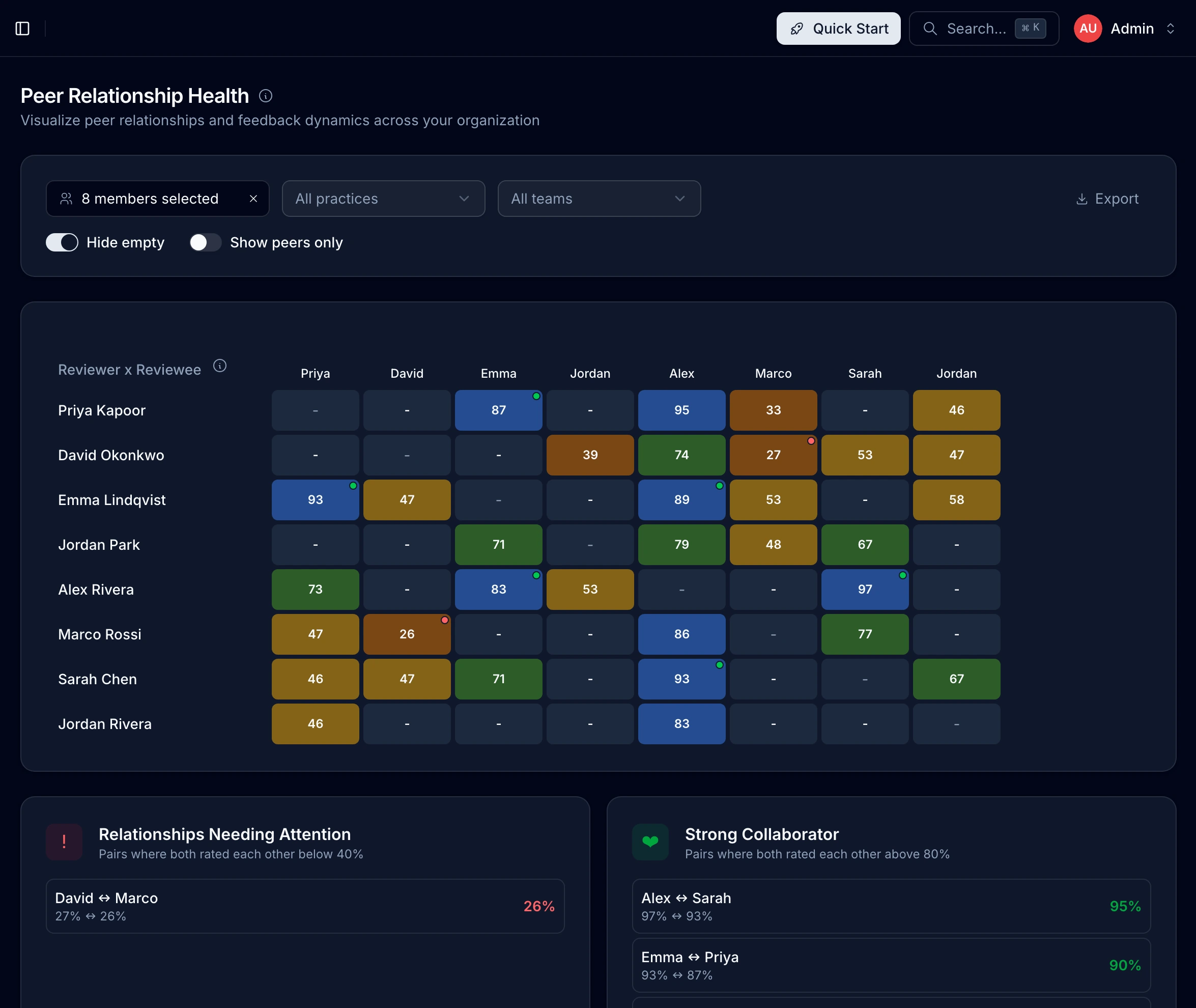
The market is shifting from feelings to performance
The CHRO conversation has shifted from employee happiness to workforce performance. HR leaders are expected to drive measurable business outcomes — not just engagement scores. Continuous performance management delivers the real-time data needed to make that shift.
Deloitte Human Capital Trends, 2024The majority of organizations know their current approach isn't working. The question isn't whether to change — it's how fast you can move to a continuous model before your competitors do.
Deloitte Human Capital TrendsAnnual reviews vs. continuous feedback
| Aspect | Annual Reviews | Continuous Feedback |
|---|---|---|
| Frequency | Once or twice per year | Continuous — customize the cadence to your org |
| Data freshness | Months-old recollections | Real-time observations |
| Admin burden | 6–12 weeks to administer | Built into daily workflow |
| Bias | Heavy recency bias | Distributed across time |
| Employee trust | 72% don't trust the process | Anonymous + attributed hybrid |
| Actionability | Too late to course-correct | Immediate coaching signals |
| Score gaming | Inflated by social pressure | Anti-gaming calibration |
Built for continuous from the ground up
Mistvine isn't an annual review tool with a feedback feature bolted on. Every component is designed for continuous performance management.
4-Tier Cascading Principles
Org, practice, team, individual behavioral principles that give every person context-aware standards.
Learn moreAnti-Gaming Calibration
Anonymous for employees, attributed for managers. Eliminates score inflation without sacrificing accountability.
Learn moreWave-Based Cycles
Time-boxed planning with per-objective sentiment voting. Teams align, execute, and reflect in 2–6 week cycles.
Learn more10-Dimension Team Health
Evidence-backed dimensions: collaboration, clarity, safety, velocity, and more. Continuous trend tracking, not annual snapshots.
Learn moreObservable Behaviors
Feedback on specific, witnessed behaviors — not vague traits. Actionable signals that drive real growth.
Learn moreCommon questions about continuous feedback
What is continuous performance management?
Continuous performance management replaces the annual review cycle with ongoing feedback, regular check-ins, and real-time coaching. Instead of evaluating performance once a year, managers and peers provide actionable signals throughout the year so employees can course-correct and grow continuously.
Why are annual performance reviews failing?
Annual reviews fail because they rely on months-old recollections, suffer from recency bias, and deliver feedback too late to be actionable. Research shows only 14% of employees find them motivating, and 72% of workers don't trust the process. The administrative burden (6–12 weeks) rarely justifies the outcomes.
How does continuous feedback improve employee engagement?
Gallup research shows that 80% of employees who receive meaningful weekly feedback maintain high engagement. Continuous feedback creates a growth-oriented culture where employees feel supported, recognized, and empowered to improve — rather than judged once a year.
What is the difference between annual reviews and continuous feedback?
Annual reviews happen once or twice a year using months-old data, take weeks to administer, and often come too late to be useful. Continuous feedback is built into daily workflow through regular cycles, uses real-time observations, and provides immediate coaching signals that managers can act on.
Why do performance reviews cause so much stress?
Neuroscience research shows that being evaluated triggers the brain's threat response — the same fight-or-flight reaction as physical danger. Performance ratings directly threaten our sense of status, flooding the brain with cortisol and impairing the working memory and cognitive flexibility needed to actually process feedback. Studies show heart rates spike up to 50% during feedback conversations. Continuous feedback reduces this by making feedback routine, low-stakes, and often employee-initiated — which cuts the stress response by half.
How does Mistvine implement continuous performance management?
Mistvine uses wave-based cycles you configure to your team’s planning rhythm, 4-level cascading behavioral principles, anonymous peer feedback (anonymous for employees, attributed for managers, which keeps score inflation in check), per-objective sentiment voting, and 10-dimension team health tracking. This replaces the annual review with continuous, actionable signals.
Ready to Leave Annual Reviews Behind?
Start your 14-day free trial. No credit card required.
Start Your 14-Day Free Trial No credit card required