
Status Meetings Are Expensive.
And Everyone Forgets What Was Said.
Your team spends hours every week in meetings that could be a structured written update. PPP (Progress, Plans, Problems) replaces verbal status reports with a searchable, accountable record that managers can actually act on.
PPP (Plans, Progress, Problems) is a structured weekly written status format in which each team lead submits three short bullet groups: what they planned to do this week, what they actually got done, and what blockers came up. The format replaces synchronous status meetings — which 71% of senior managers (Harvard Business Review) say are unproductive — with an asynchronous, searchable record that managers and stakeholders can read on their own schedule and reference in retrospectives, performance reviews, or audits. The discipline forces teams to articulate plans up front (not just react to whatever lands), to write down blockers explicitly (so they get unblocked), and to leave a permanent trail of what was committed versus what shipped. PPP scales because it is short (three bullets per section, ten minutes a week), structured (the same three buckets every time), and locked once the cycle ends so the record cannot be rewritten after the fact.
Meetings cost more than you think
The average knowledge worker loses days every month to meetings that accomplish nothing. The information shared verbally is forgotten within hours. The cycle repeats every week.
What the research says
Written Goals, Better Outcomes
People who write down their goals and send weekly progress updates to an accountability partner achieve them at twice the rate of those who keep goals in their heads. PPP turns this research into a weekly habit — Progress documents wins, Plans commit to next steps, Problems surface blockers before they escalate.
Weekly Feedback Drives Engagement
The single most powerful lever for engagement isn't perks or pizza — it's the frequency and quality of feedback. Employees who receive meaningful weekly signals are dramatically more engaged, less burned out, and less likely to be searching for a new job.
Reflection Improves Performance
Harvard Business School research found that employees who spent just 15 minutes at the end of each day writing reflections on lessons learned performed significantly better. PPP builds this reflection into the work week — structured thinking about what happened, what's next, and what's in the way.
PPP Entry
Structured Updates in Under 5 Minutes
Team leads submit Progress, Plans, and Problems for each team — replacing unstructured status meetings with a searchable weekly record.
See this feature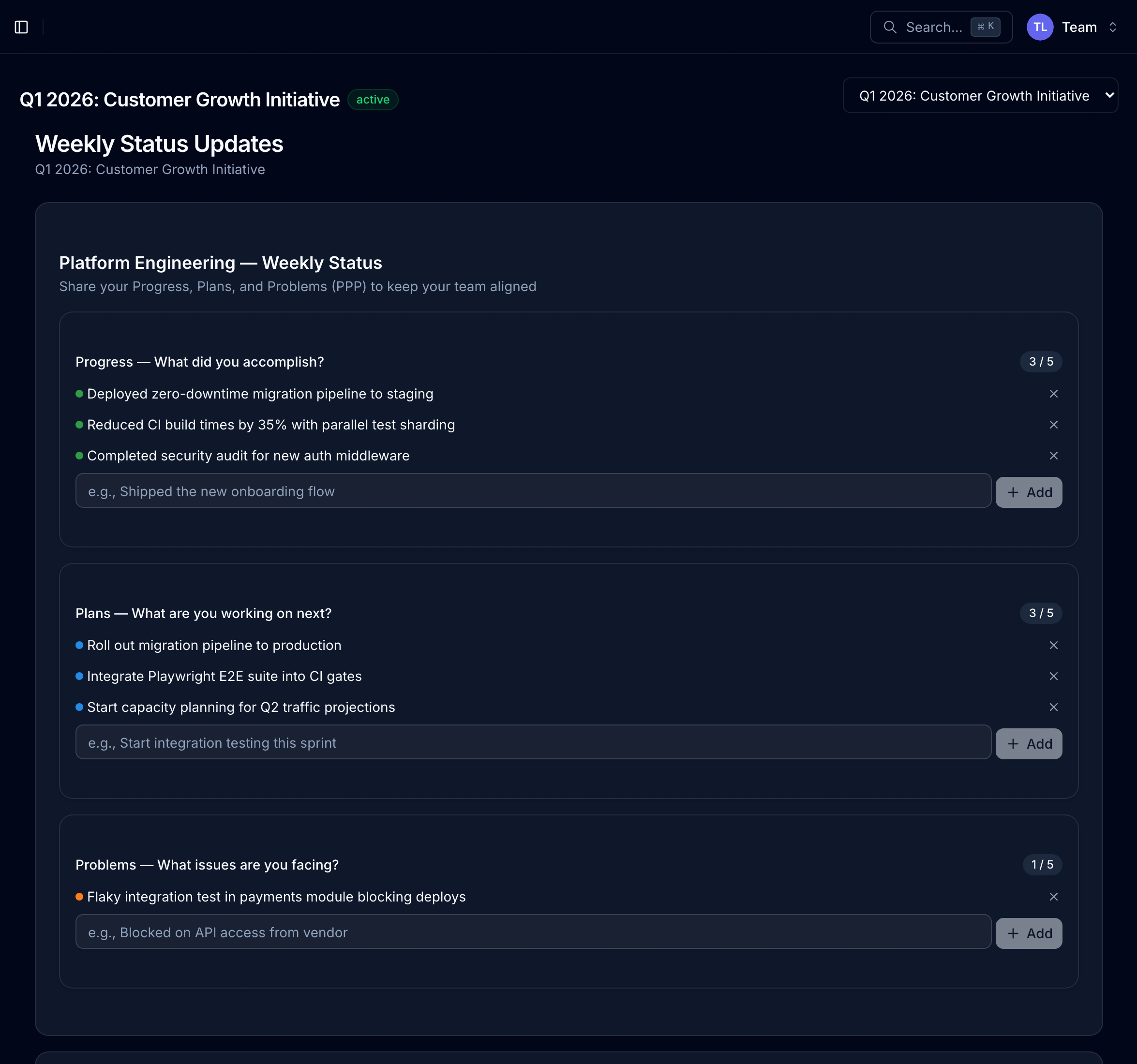
Wave Admin View
Every Team's Status at a Glance
Wave admins see all team PPP submissions in one view — spot blockers early, track momentum, and skip the round-robin update meeting.
See this feature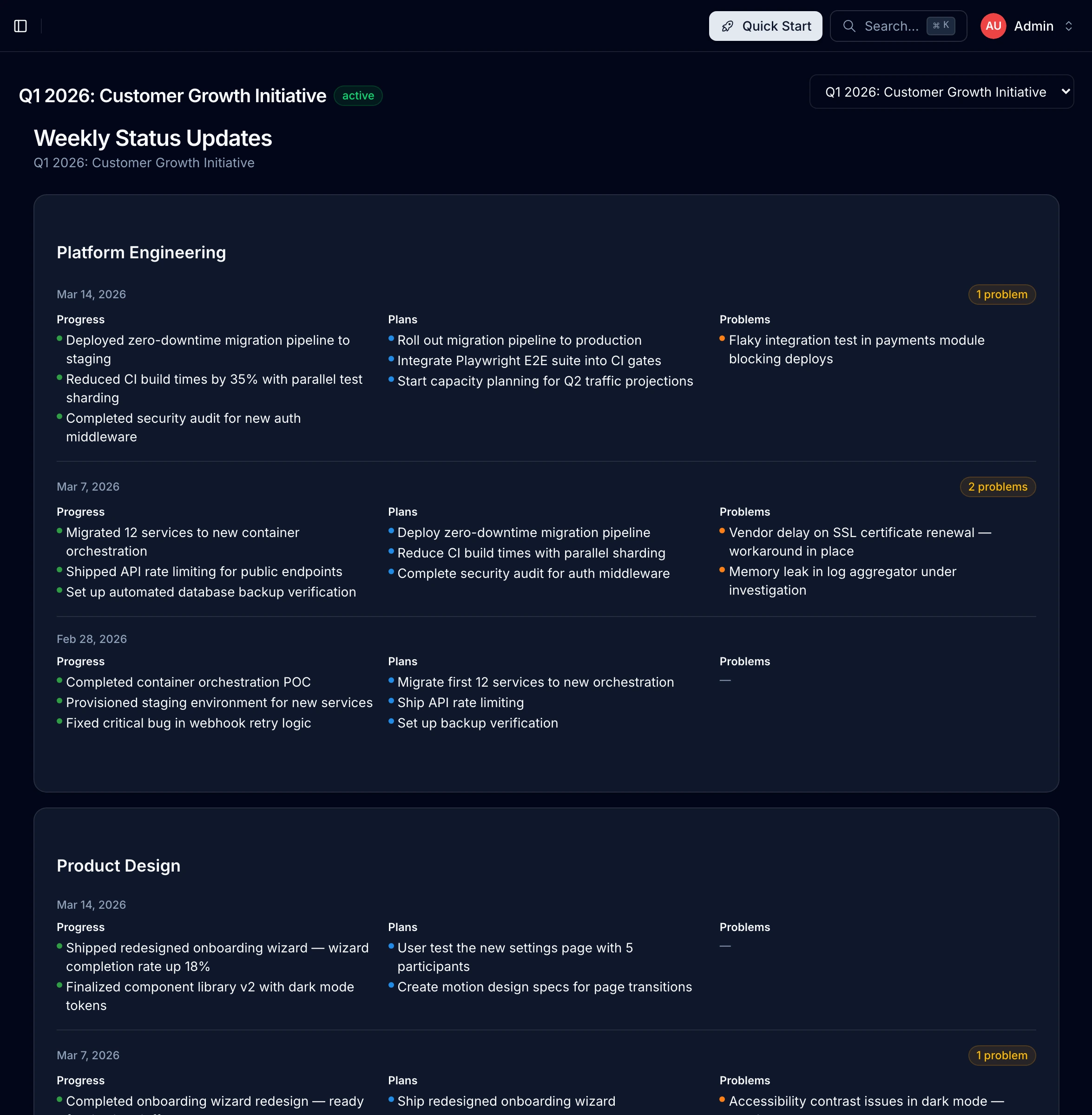
The engagement crisis is a visibility crisis
Only 21% of employees globally are engaged. Managers account for 70% of the variance in engagement scores. The teams that check in weekly with structured updates create the feedback loops that keep people connected to their work — and their managers connected to reality.
Gallup State of the Global Workplace, 2025The solution isn't more meetings with better agendas. It's replacing low-value synchronous rituals with structured async check-ins. Teams get their time back. Managers get better data. Everyone wins.
Atlassian State of TeamsStatus meetings vs. structured PPP check-ins
| Aspect | Status Meetings | PPP Check-Ins |
|---|---|---|
| Format | Verbal, unstructured, varies by meeting | Written: Progress, Plans, Problems — every week |
| Time cost | 31 hours/month in unproductive meetings | 10 minutes to write, read anytime |
| Information retention | 70% forgotten within 24 hours | Permanent, searchable written record |
| Manager visibility | Filtered through what people choose to say | Structured data with problem-flagging |
| Focus time impact | Interrupts deep work, 23 min to recover | Async — write and read when it suits you |
| Historical record | No record unless someone takes notes | Auto-locked weekly history, exportable to CSV |
| Escalation path | Problems mentioned verbally and forgotten | Problems tracked → boost requests for cross-team help |
Check-ins that feed the coaching engine
Most check-in tools collect updates and stop there. Mistvine's PPP is wired into the entire performance system — problems surface in coaching insights, patterns emerge across waves, and managers get a complete picture without scheduling another meeting.
Structured PPP Format
Progress, Plans, Problems — up to 5 items per category. No free-form rambling, no missed sections. Teams build a consistent rhythm that managers can scan in seconds.
Learn moreAuto-Locking History
Each week's PPP auto-locks when the wave ends. No retroactive editing, no revisionism. A permanent record of what was said, when — exportable to CSV for reviews or audits.
Learn morePPP Matrix View
Leadership sees all teams' PPP in one table — filterable by "only teams with problems." Spot blockers across the organization before they become crises.
Learn moreCoaching Insights Integration
PPP data feeds the rules-based coaching engine. When a team flags the same problem for three weeks running, it shows up in their manager's coaching brief automatically.
Learn moreSlack Integration (Coming Soon)
Team leads will be able to view and add PPP items directly from Slack. No context switching, no forgotten updates. The check-in meets teams where they already work.
Learn moreCommon questions about weekly ppp check-ins
What is PPP (Progress, Plans, Problems)?
PPP is a structured weekly check-in format where teams report three things: Progress (what was accomplished), Plans (what's coming next), and Problems (what's blocked or at risk). Used by companies like Apple and Meta, it replaces unstructured status meetings with a consistent, written record that managers can act on.
How does PPP replace status meetings?
Instead of pulling everyone into a room to verbally share updates (which are 70% forgotten within 24 hours), PPP captures the same information in a structured written format. Managers read updates asynchronously, focus 1:1 time on coaching and problem-solving rather than information gathering, and the entire team reclaims hours of meeting time every week.
Who fills out the PPP in Mistvine?
Team leads submit PPP updates on behalf of their teams each week. This keeps the signal consistent and manageable — one structured update per team per week, rather than individual status reports that create noise. Team members contribute through sentiment voting and individual goals.
What happens when a team reports a Problem?
Problems are visible in the PPP Matrix View, where leadership can filter to show "only teams with problems." Persistent problems surface in coaching insights. Teams can also create boost requests — cross-team help requests tied to objectives — when they need support from other teams to resolve blockers.
Will PPP be available via Slack?
Slack integration is coming soon. Team leads will be able to view their current PPP and add items directly from Slack — no need to switch to a separate tool. The check-in will meet teams where they already work.
How does auto-locking work?
Each week's PPP auto-locks when the wave cycle ends. Once locked, entries cannot be edited or deleted. This creates an honest, permanent record — no retroactive changes, no revisionism. All locked history is exportable to CSV for reviews, audits, or retrospectives.
Is PPP the same as a standup?
Similar intent, different execution. Standups are synchronous, verbal, and daily — they interrupt focus time and leave no written record. PPP is async, written, and weekly — it creates a searchable history, respects deep work time, and gives managers data they can actually reference weeks or months later.
Ready to Replace Status Meetings?
Start your 14-day free trial. No credit card required.
Start Your 14-Day Free Trial No credit card required